
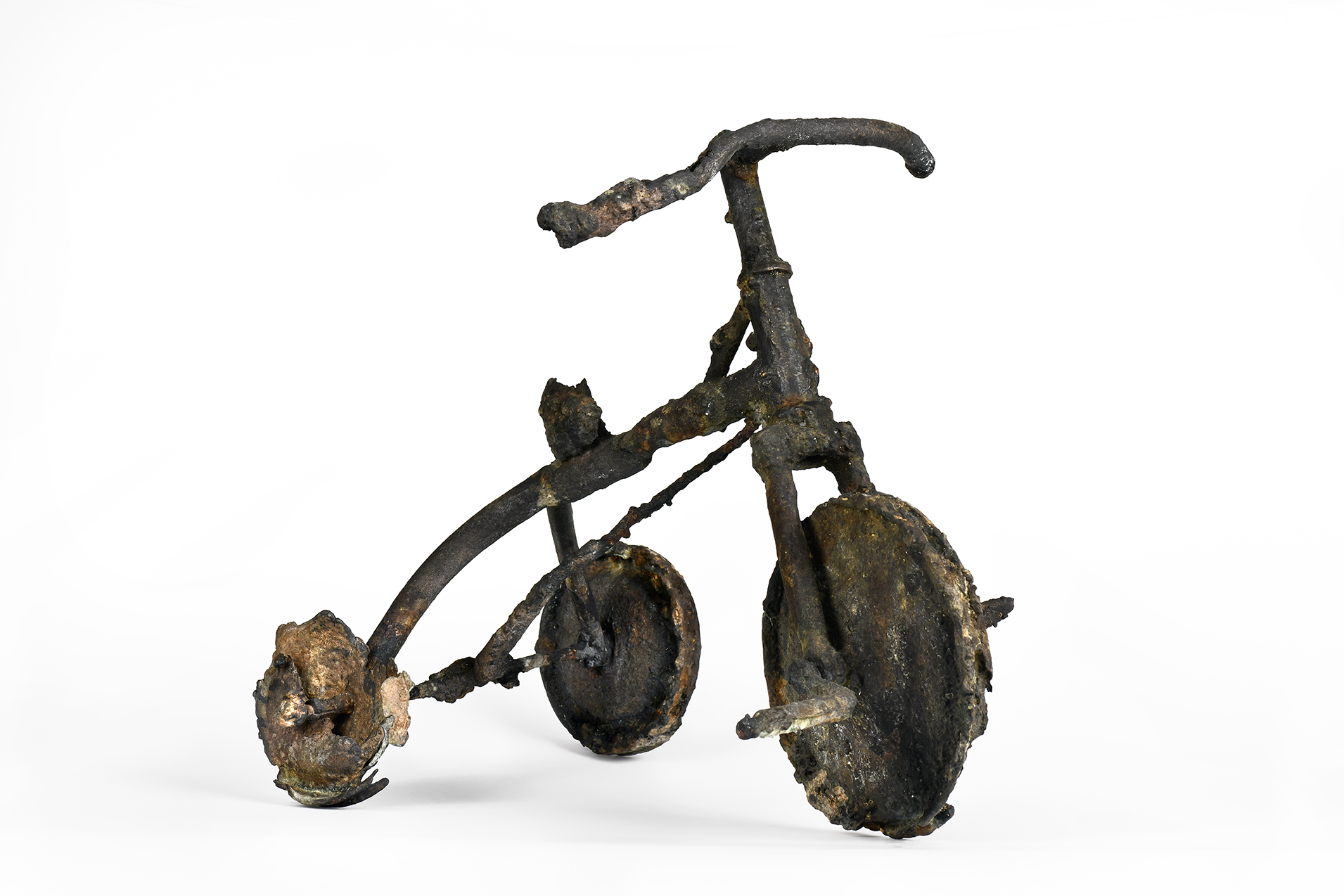
At the entrance of the International Red Cross and Red Crescent Museum, in Geneva, visitors can find a replica of a playful object: a tricycle. The original piece is exhibited elsewhere, at the Hiroshima Peace Memorial Museum. Once belonged to the three-year-old Schinichi Tetsutani, who was playing with it when the atomic bomb was dropped in Hiroshima, the toy has become a memory artifact. The playfulness in it has become a powerful medium for bearing witness to the horrors of nuclear extreme violence. Playfulness can also be a specific way of entangling (within) the world. In the case of the tricycle replica at the Red Cross Museum, 1Future artists used 3D scanning to create a digital baseline to craft the piece. For them, this form of design is ‘an innovative way of experiencing the historical artifacts.’ Design plays with a playful thing. As a phenomenon and as a form of engaging with the world, how does playful design affect international relations?
On August 28th, 2026, Professor Anna Leander (HUD-IHEID PI) and Lucas Perez Florentino (HUD-IHEID Research Assistant and Coordinator) convened the workshop ‘Playful Design: Making International Relations Differently?’ at the Geneva Graduate Institute to reflect on this question. The workshop was a part of a series of events organized by the HUD-IHEID team to promote academic exchanges on the politics of design as a situated praxis aimed at reconfiguring – through improvisation, repurposing, intervention, creativity, innovation – contexts of international security and humanitarianism marked by precarity.
Participants were invited to reflect on the ambivalences of playfulness as a form of entanglement with sociomaterial reality, while exploring how it materializes in specific formats and practices of design as well as how material-aesthetics participates in it as a political performance. The main guiding questions examined the extent to which playful design reiterates existing ‘serious’, apparatuses of power and/or whether it opens genuine room for repair and reimagination.

The workshop was transdisciplinary, bringing together scholars in Anthropology, Digital Design, International Relations, War and Strategic Studies, from institutions across Latin America and Europe. The presentations covered a wide range of topics and cases involving playful design in international security, from child toys to military wargaming, from generative AI to classical war thinking, from humanitarian care to memetic content in digital spaces, and from nuclear governance to disaster preparedness. Throughout the workshop, participants debated the prospects and limitations of playful design as a form of inquiry – a collage method, a conceptual framework, a theory, or a digital intervention – and as phenomena under inquiry – a governance and legal technology, a form of authority/resistance, a mode of being, or an enterprise.
For more information, see the conceptual note and full programme below.