
Can technology strengthen ecosystems of psychosocial support in the most complex humanitarian settings globally?

Jonathan Luke Austin
Professor
The University of Copenhagen
jla@ifs.ku.dk

Rachel Howell
Senior Researcher
EssentialTech, EPFL
rachel.howell@epfl.ch
Psychosocial health in humanitarian settings: a transversal crisis
- Over 65 million people in humanitarian need also suffer from a mental health condition;
- In low and middle-income countries between 76% and 85% of people receive no treatment for mental illness;
- Levels of psychiatric bed provision in low and middle-income countries have stagnated or declined since 1990;
- The prevalence of mental illness has not declined globally for over 25 years.


1.
Preventing a dangerous feedback loop
Humanitarian crises – of all kinds – disrupt the psychosocial ecologies that are vital for human well-being. Communities become fragmented, trauma is transmitted across kinship networks, economic precarity disrupts protective institutions, and uncertainty undermines psychological security. The result is a well-documented rise in the risk of mental health conditions among a large part of affected populations. Those conditions – in turn – risk increasing the likelihood of further humanitarian crisis in a dangerous feedback loop.
Consider prisons and detention. Armed conflict increases violence, insecurity, and poverty, causing widespread psychosocial distress. This raises the risk of people turning to crime, substance abuse, or social exclusion, making them more likely to be detained in prisons or camps with extremely poor living conditions. Detention thus worsens mental health, leaving individuals more vulnerable upon release and increasing the likelihood of behaviors that further undermine security—ultimately intensifying the humanitarian crisis.
It is for this reason that mental health and psychosocial support (MHPSS) is critical not only to reduce immediate suffering or provide healing, but also as a linchpin of humanitarian prevention. Improving psychological and community well-being reduces fragility, preventing future crises, instability, or fragility. Equally, when approached through a context-sensitive and psychosocial perspective, MHPSS interventions can help the wider humanitarian mission expand its horizons through the integration of local or indigenous knowledge, innovation, and practice.
Nonetheless, despite several decades of crucial work expanding the place of MHPSS in humanitarianism, concrete change on the ground has been slow. This is because MHPSS interventions remain extremely (human) resource intensive in any setting, but especially in humanitarian situations where needs are extremely high, but trained medical professionals are in short supply, necessary infrastructure is frequently lacking, and a biomedical as opposed to psychosocial approach has sometimes been too dominant.

Schematic description of the violent feedback loops caused by mental illness in detention. © Jonathan Luke Austin
2.
An x-ray for MHPSS?
X-rays revolutionized medicine. They provided a rapid non-invasive form of patient diagnosis and so avoided the once common need for doctors to cut open bodies unnecessarily, searching for ailments. Something that led to many millions dying unnecessarily, in great pain. Moreover, x-rays where one of the first technologies to have their designs adapted for humanitarian purposes. During World War I, Marie Curie quickly saw that many injured soldiers were having limbs amputated unnecessarily, due to the lack of x-ray equipment on the front lines. She therefore developed, and found funding for, mobile radiography units, popularly known as petites Curies, that hosted self-contained x-ray machines, generators, and photographic darkroom equipment on vehicles sent to the front.
But mental health and psychosocial support services (MHPSS) still inhabit a dangerous and painful past: a world without rapid, mobile, and non-invasive screening, triage, and treatment for mental health and psychosocial conditions. There are no equivalent ‘mobile’ MHPSS screening devices for humanitarian contexts. Instead, MHPSS remains extremely resource intensive, increasing global human suffering, and limiting its crucial role in humanitarian prevention.
But change is possible. Emerging technology allows us to imagine an x-ray for MHPSS. Computerized adaptive testing and machine learning tools potentially allow for the rapid transdiagnostic screening and triaging of mental health: easing the challenge of limited human resources in humanitarian settings. Just as a physical x-ray allows clinicians to determine whether a patient needs urgent care, an x-ray for MHPSS would allow primary healthcare workers to triage populations in a few minutes with digital tools capable of testing for multiple mental health conditions (PTSD, depression, psychosis, etc.) simultaneously. Simply: these technologies potentially allow us to non-invasively, sensitively, and with few resources ease the burden of humanitarian MHPSS.
But mental health conditions are not broken bones. Their aetiologies are far more complex. Social, political, economic, and humanitarian drivers are at least as important as any biochemical or other cause, and effective treatment of these conditions can never be reduced to medicine. This is especially true in low-income and humanitarian contexts.
As such, any imagined x-ray for MHPSS must provide a context-sensitive and politically aware ‘image’ of a phenomenon whose drivers exist far outside the mind or body of individual patients.

Illustration of the concept of an ‘x-ray for MHPSS’ in which psychosocial risks are identified in the ecologies of an IDP camp. © Jonathan Luke Austin
3.
Innovation from the global south
“Why is there no humanitarian technology in the Congo? Why hasn’t it been mobilized for us?”
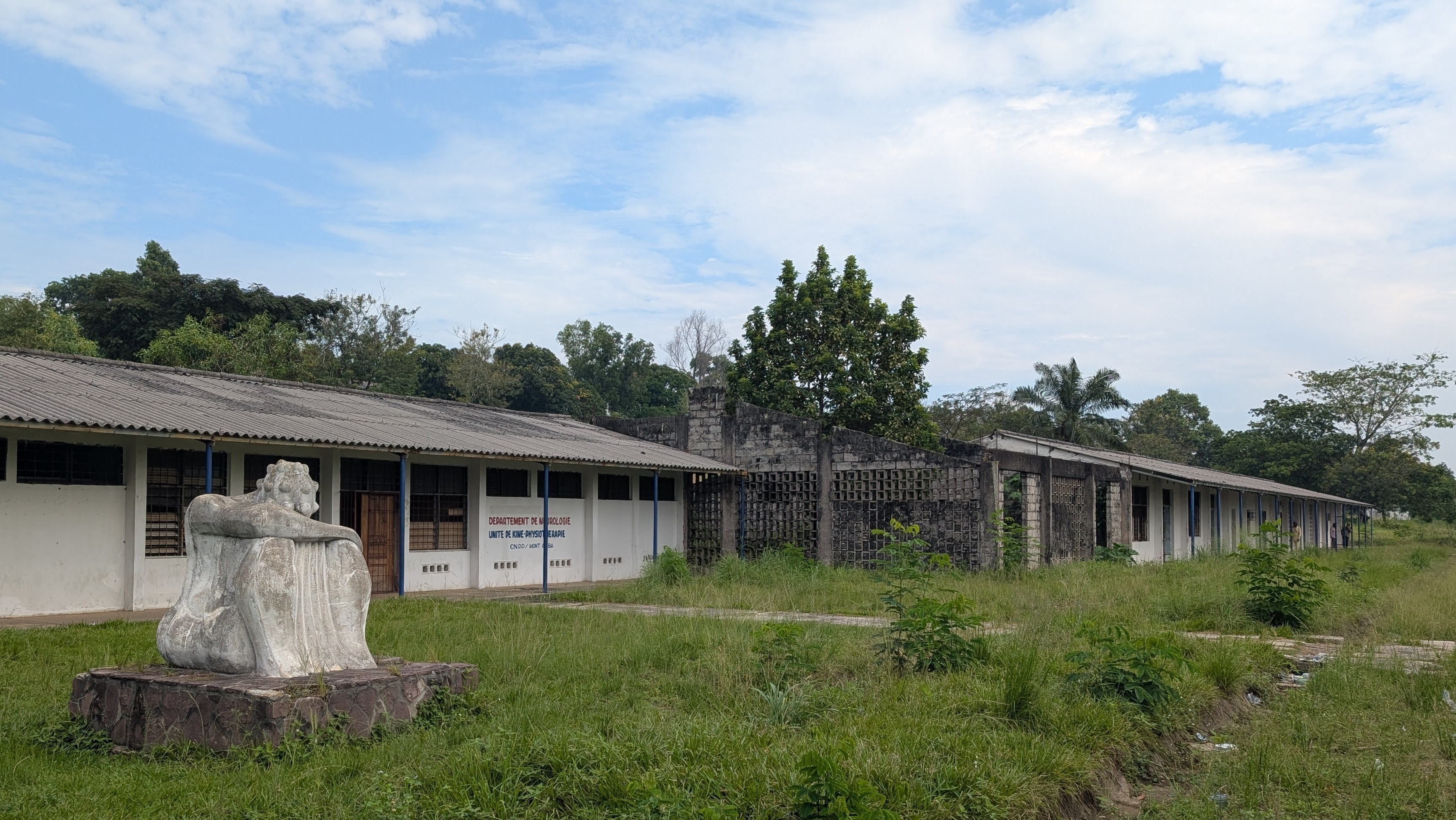
This question was posed by a Congolese expert at the close of a HUD-organized workshop on mental health and technology in Kinshasa, the Democratic Republic of the Congo (DRC). It reflects a sense of injustice at the neglect of places like the DRC when it comes to introducing potentially emancipatory technologies for their benefit. The statement, of course, was not naive: awareness of technocolonialism and solutionism also dominated discussions during the different events organized in the DRC and other countries when exploring mental health and technology. But the consensus has been clear: technology can and should play a role, albeit one defined from the lived experience of those living through humanitarian problems.
Our research in this area has thus been designed based on the ‘ground truths’ of places like Kinshasa. Indeed, rather than beginning with a preordained focus on mental health, psychosocial care, or any particular technology – these foci emerged through a more than year-long process of bottom-up needs assessment. This has included stakeholder engagement with civil society, activists, local humanitarians, and others across the DRC (Kinshasa, Beni, Goma, Bukavu) and Colombia (Bogota, Barranquilla, Medellin), as well as global networks.
These collaborations are important not only because they assure the ‘contextual fit’ of digital MHPSS interventions but also because they position these most protracted and acute of humanitarian crises as a source of ‘reverse innovation’ — teaching us lessons with critical relevance for mental health and psychosocial practice across the entire world. HUD thus hopes to develop scalable mental health initiatives that are led from the global south. The importance of this is twofold. Global mental health policy is often critiqued for its Eurocentricism; exporting biomedical health paradigms that fit poorly elsewhere and extenuate forms of epistemic injustice. At the same time, these biomedical paradigms have failed to produce substantial change in wealthy nations, where a transversal mental health crisis also exists. Developing mental health initiatives from the ground of ‘crisis’ is thus not simply a decolonial move, but one that might transform our understanding of mental health. In this, our guiding ethos is shaped by the Congolese saying malembe, malembe — to work slowly, slowly, carefully, carefully, or calmly, calmly — to drive sustainable change, whether technologically, socially, or politically.

Partners explore humanitarian MHPSS technologies in Kinshasa, the Democratic Republic of the Congo. 
Partners explore humanitarian MHPSS technologies in Kinshasa, the Democratic Republic of the Congo. 
Partners explore humanitarian MHPSS technologies in Kinshasa, the Democratic Republic of the Congo. 
Partners explore humanitarian MHPSS technologies in Kinshasa, the Democratic Republic of the Congo. 
Partners explore humanitarian MHPSS technologies in Kinshasa, the Democratic Republic of the Congo. 
Partners explore humanitarian MHPSS technologies in Kinshasa, the Democratic Republic of the Congo. 
Partners explore humanitarian MHPSS technologies in Kinshasa, the Democratic Republic of the Congo. 
Partners explore humanitarian MHPSS technologies in Kinshasa, the Democratic Republic of the Congo. 
Partners explore humanitarian MHPSS technologies in Kinshasa, the Democratic Republic of the Congo. 
Partners explore humanitarian MHPSS technologies in Kinshasa, the Democratic Republic of the Congo.

Partners explore humanitarian MHPSS technologies in Bogota, Colombia. 
Partners explore humanitarian MHPSS technologies in Bogota, Colombia. 
Partners explore humanitarian MHPSS technologies in Bogota, Colombia. 
Partners explore humanitarian MHPSS technologies in Bogota, Colombia. 
Partners explore humanitarian MHPSS technologies in Bogota, Colombia. 
Partners explore humanitarian MHPSS technologies in Bogota, Colombia. 
Partners explore humanitarian MHPSS technologies in Bogota, Colombia. 
Partners explore humanitarian MHPSS technologies in Bogota, Colombia.

4.
Connected to global humanitarian networks
HUD’s work on digital MHPSS is complemented by a cross-institutional and international Technical Working Group formed to link the realities of humanitarian MHPSS on the ground to international humanitarian operations globally. The working group draws on the expertise of mental health and psychosocial support experts from organizations including the International Committee of the Red Cross (ICRC), Terre des hommes, the International Federation of the Red Cross and the Red Crescent (IFRC), and related NGOs. The working group also includes the expertise of leading computer scientists, experts in global health, development engineers, and social scientists from anthropology, geography, and sociology. The goal of the technical working group is to support the scalability of HUD’s intervention in this area, providing technical expertise on its integration into existing global health systems, further insight into context-sensitivity, and beyond. The technical working group convenes regularly, including through participation in core workshops exploring progress to date.


5.
Towards ADAPT-MH
Based on its work to date with partners in the global south and humanitarian sector, HUD now aims to develop a transdiagnostic and scalable electronic clinical decision support (e-CDSS) system, drawing on emerging technologies such as computerized adaptive testing and machine learning. Specifically, developing ADAPT-MH (Adaptive Psychosocial Triage Technology for Mental Health) will involve three main tasks. First, we will train an algorithm to simultaneously detect multiple mental health and psychosocial conditions (PTSD, depression, psychosis, etc.) in a few minutes of screening, as opposed to the hours this process currently takes. Technically, this algorithm has the potential to overcome the extreme limits on human resources in humanitarian settings. Second, this algorithm will be integrated into a front end e-CDSS through extensive user experience design and testing with our partners in humanitarian settings, in order to ensure contextual fit across global space. Third, alongside developing the user interface for ADAPT, we will integrate a capacity-building or training component, following the work of the WHO’s mhGAP-IG program, which aims to further improve local MHPSS capacity through a human-technology feedback loop.
In all this, ADAPT-MH is envisaged as being:
Transversal:
ADAPT-MH must be transversal in its functionality, combining transdiagnostic screening (for diagnosis, triage, and referral), training (for capacity building, stepped care, task sharing), and analysing data (for population-level data analytics). This multifunctional platform would augment (not replace) human capacity and provide sustained buy-in. Simultaneously providing time-saving tools (screening), capacity building (training), and analysis (data analytics) has the potential to create long-term commitment among primary health care workers and authorities to a platform.
scalable:
ADAPT-MH must be scalable across primary care, institutional, and political contexts. Too often, MHPSS or medical technologies more generally are fragmented in their development and deployment – following a silo-logic, which restricts their scale, reach and value-added for the user as multiple platforms are developed across different organizations, for (too many) different users, and so forth. At a minimal level, a context-neutral platform is thus required, appropriate for different users.
modular:
ADAPT-MH must be modular. Despite the need for basic functionality that is context-neutral, a truly scalable digital MHPSS e-CDSS system must also be adaptable to the specific needs of users. In an ideal-world, this would include the possibility of ‘plugging-in’ context-related modules to the overall platform – modules relating, for example, to different cultural idioms of distress, different languages, different social, political, or humanitarian settings, and so forth. This would also future proof such a platform, which is also crucial for its long-term sustainability as the project moves forward.
Below is a schematic description of where such a digital e-CDSS system would fit in the ‘flow’ of a primary health care system – alternating between health worker training, patient screening, and data analytics.

Schematic description of how ADAPT-MH would intervene into MHPSS pathways in humanitarian contexts.

6.
ADAPT-MH: Disrupting dangerous feedback loops
Based on IASC MHPSS Guidelines · WHO mhGAP · Sphere Standards
Triage & Prioritisation
- Risk stratification at intake
- Population-level screening
- Urgency flagging for clinicians
- Early warning indicators
Augmented Diagnosis
- Multi-layer condition profiling
- Non-specialist interpretation
- Culturally contextualised scores
- Longitudinal tracking
Treatment Pathways
- Matched referral recommendations
- Community-based interventions
- Stepped-care guidance
- Resource allocation support
7.
Learn more

ADAPT emerges from intense basic research in the Congo and Colombia exploring violence in detention. This includes the ethnographic interviewing of former detainees, the cartographic mapping of detention spaces, and sustained work with medical professionals, civil society, and others. Find out more about our basic research here.

ADAPT’s design criteria were developed bottom-up through a participatory methodology of co-design. In this, the goal is to develop technological innovations led from the needs of the global south but which are also applicable to global mental health problems. Find out more about our co-design methodology here.

For more details on the development of ADAPT you can consult this white paper, which provides a meta-review of existing initiatives in this area, details on the methodological logic of ADAPT, and planned future research. Read the white paper here.