

Nora Doukkali
HUD PhD Researcher
Geneva Graduate Institute

Luis Carlos Tovar
Visual Artist
Below, HUD PhD Researcher Nora Doukkali engages in a dialogue with Luis Carlos Tovar, a Colombian visual artist, who circulates between France and Colombia. His main research interests are discontinuous geographies and the notion of post-memory (namely, the experiences and representations inherited from previous generations) in contemporary art. Particularly interested in post-photography and archives, he explores the processes of creating otherness and the way in which personal memories shape collective memory. His work incorporates a range of media, including photography, film and video, printmaking, collage and installation. He favors long-term projects involving in-depth historical research.
I met the artist Luis Carlos Tovar at his exhibition Palonegro at the Photographic Center of Geneva in October. A few weeks later, we found ourselves in a café in Paris to discuss cartography, counter-geography, and autogeography. A conversation that led us to the territories of escape in Palermo, the power of drifts and metaphors, the cypress trees of the Verano cemetery in Rome, and the plastic chairs that populate the beaches of Colombia.
N.D.: Your work is based on in-depth research that intertwines the roles of historian, geographer, and archaeologist, but you also establish an intimate and sensory connection with space. I would like to know more about how you engage with the places where you work. How do you articulate the exploration of various layers of archives with a more intuitive approach?
L.C.T.: For example, my project Autogeografías is a series of inventories, which is like an attempt at appropriation on my part as an artist and as a subject. I grew up in a way that was very isolated, without knowing the boundaries of the territory of Colombia. This project of Autogeographies has been, in a way, a claim to appropriate my country. I left Colombia 8 years ago; a way of not losing the connection with my country is to work with archives. In the process, it is essential to listen to both the territory and the archive. I am interested in orphaned and dormant archives; this is where I find great potential for creation and activation. When I work with archives or maps, they transform into witnessing objects, they speak to me. I believe that a large part of my work is related to the connection between the two: the landscape as an archive or the archive as a landscape.
That is how I began to read Élisée Reclus (1830-1905). Élisée Reclus was the son of a Protestant, and his father wanted him to become a priest. He entered a spiritual crisis and decided to become a geographer, writer, and anarchist. He is a very radical figure who had to go into exile in Brussels and Geneva. For me, he is very interesting. With his journals, Élisée Reclus traveled to Punta Gallinas, the northernmost point of the country, in La Guajira. He mapped his journey to Panama, which at the time was part of Colombia. Unlike the geographers of his time, who tended to focus on supposedly objective and neutral descriptions of spaces, he developed an integrative approach, considering human, economic, and political aspects as well as the interaction between humans and nature. He analyzed and criticized the impact of colonialism and human and environmental exploitation.
Did you know that Jules Verne used many of Élisée Reclus’ travel journals for his stories? It is fascinating to read interpretations of the territory from the outside and confront them with those from the inside, with contemporary events; there is as much fiction as there is truth, understanding truth as an individual construction. In the case of Reclus’ travel journal to the Sierra Nevada de Santa Marta, it was important and inspiring to read his contradictions as the narrator of a poetic and anarchist ethnography in Colombian territory. This led me to realize that I had to create my own interpretation of that territory. That is why I dedicated myself to exploring the entire Caribbean part of Colombia. For five years, I lived on the coast and visited over 348 beaches. My intention was to travel, but also to photograph. I was obsessed with the idea of creating a geographical inventory.

I studied architecture and the arts, which connected me with a theorist named Francesco Careri, who talks about drift as an aesthetic act, walking as a performative gesture. This is closely linked to the Situationists and the Dadaists. I felt very inspired by this. Francesco Careri came to Colombia, invited by the architect Tatiana Urrea, and I was able to meet him. We went on some nocturnal drifts in Bogotá. At that time, I was 22 years old. This greatly inspired me as a working method to decentralize my process.
N.D.: It is fascinating to see what the approach of drift can reveal when extended over several years. Over time, it can uncover things accidentally…
L.C.T: Yes, of course. At first, I wanted to do something symbolic: a handful of sand that I would put in a small bag. Gradually, as I did this at each beach, I began to notice that the color of the sand was different. I also always found plastic chairs, which seemed quite terrible to me, as the Caribbean has a craft tradition of carpentry. So, the first series I created was photographing the sand and chairs I found.
But, to whom did these chairs belong? To the inhabitants of the sea. I started to talk with the people sitting in these chairs. Who were they? Mostly fishermen. Sometimes, they were fishermen who had lost their jobs and were now informal vendors. Other times, they were caretakers. Thus, I discovered strange stories. And without realizing it, after three years, someone told me: “Well, with your inventory, you have proof of how coal exploitation has affected the Caribbean.” Fifty percent of that coal was going to China for hydroelectric plants, and twenty-five percent to the Netherlands and Germany. I did not know this, but I was told that the ships have no ecological process for extracting coal from the mine to the boat, which has created pollution throughout the Caribbean. This changed regulations for fishermen, and as a result, half of them became unemployed.


Initially, my intention was simply to walk, to lose myself in a drift, without knowing where I was going. But after three years, my project became very political. I began systematically visiting the purest areas, which were on the route of Élisée Reclus, all the way to the most polluted ones, including border areas guarded by military personnel. I saw completely black beaches, affected by coal. The project, in the end, has many layers. First, it acknowledges that these inhabitants were a floating population. At the same time, these are very touristy areas during the high season, but when there is no tourism, they become areas of exploitation in the department of Magdalena. What I do with my work is a form of reclamation concerning the transformation of the landscape.
N.D.: And your artistic practice allows for a certain form of reclamation: a reclamation that mobilizes the material aspect of things. These are curatorial acts that use objects and materials in both a metaphorical and literal way.
L.C.T: Of course, it is a reclamation, but for me, it is a reclamation with the material. I am not an activist; that is not my way of working. However, the way I carry out my work is very political because I make metaphorical claims. I believe that what is metaphorical is sometimes more transcendent and allows for other poetic interpretations that relate more to language than to a pamphlet-like political demand.
For example, Cildo Meireles, an artist I really like in Brazil, said that “art has the capacity to create microscopic but permanent changes”. And I firmly believe in that. It doesn’t depend on one person to make that change, but in the process, how you build and socialize your work, and create a bridge between communities and institutions, you may get lucky… it doesn’t always happen that way, but when it does, it gives more meaning to the artistic practice.

Coal pollution, for example, how do we show it? How do we display the results of a research project? In the installation The Waiting Room, the obstruction of a 5-ton mountain of export coal acquired from the black market in Santa Marta, with the bodies of visitors unable to move from one room to another, makes it very tangible. It is a theme that cannot be avoided. At that time, there was significant denial on the part of the Colombian state in recognizing coal pollution in the ports of Magdalena.
Another example involves the chair, which illustrates the consequences for fishermen. Many end up selling mobile phone minutes. For instance, a fisherman was sitting with a mobile phone, selling cellular communication minutes. From a political perspective, this seems very interesting to me, but also from a poetic perspective: it is like selling time.
The chair, as an object of representation, has become a parallel project. The chair serves as the first hierarchical object of political representation of human beings. In the indigenous communities of the Sierra Nevada de Santa Marta, their spiritual leaders are called “mamos,” and they sit on a small chair, a “butaco” they have carved. For me, the plastic chair is in some ways the “throne of the people.” Subsequently, I decided to make imprints of these chairs as a form of reclamation of the territory. Many fishermen I met had chairs that they had repaired because they were broken. This is where I began to be interested in the possibility of “repair”, “cure”. They were repairing the chairs to give them a longer life, and that gesture of repair made me reflect on the obsolescence of things, the place that humans occupy in that transition, and the role of memory in that territory.


In the Palonegro project, focused on the Thousand Days’ War (1899-1902), I also chose materials to restore the archives of Colombian soldiers who did not receive their pensions, such as the ribbon, which serves as a metaphor for healing and is used very concretely to restore photographic images. So, for me, it has this dual meaning: the material and physical repair of memory and the representation of violence in Colombia.

N.D.: With the project Future of Humanitarian Design (HUD), we also engage in a reflection on how we represent the other, alterity, what different modes of representing others do, what they show and what they silence. Can you tell me about how you approach alterity in your artistic and curatorial practices, particularly concerning the fishing communities you have encountered?
L.C.T: It is important to know that more than 80% of these fishermen were not originally from the region; they did not belonged to the department of Magdalena. They had been displaced previously due to violence and had learned the fishing trade. At first, I thought: well, I do not often take portraits, as it is not something I particularly enjoy.
Eventually, I agreed to take their portraits if they wished to participate in the project, but from a reflection inspired by Johann Kaspar Lavater. Lavater was a somewhat mystical scientist who, in the 19th century, invented a machine intended to capture the human soul. The machine consisted of a chair, a candle, a cloth, and the projection of shadows. He would draw the contours of this projection.
In the field of art, the history of shadow has been used as a means to explore alterity and the memory of the Other. I wanted to focus on this way of approaching alterity. It draws from a deeper history, the shadow in the myth of Corinth. The “Corinthian Maiden” traced the shadow of her lover on a wall to preserve his image as a memory during his absence. Subsequently, this idea was transferred to ceramics and, later, to Renaissance cameos.
Returning to Lavater, he created a science called profilometry. This system, this methodology, was later used in a police manner by the English and marks the beginning of what we know today as identity photography.


N.D.: We have just spoken about representation in exhibition spaces, but how do you envision the appropriation of these spaces? And perhaps the desire to move beyond these spaces? Have you exhibited in other spaces, perhaps more liminal, outside of museums?
L.C.T.: I place a strong emphasis on workshops in my projects and help design educational materials. What happens a lot in Colombia is that museums are very centralized. Therefore, what I did with the children of the fishermen was decentralize the museum; the museum goes to them. Part of what we tried to do involved exercises with different populations to participate in a reflection on their territory. It serves no purpose for me to be critical of pollution if they are not included in the reclamation of this territory.
N.D.: And in another project – Cartographies of Escape – art even unfolds on the walls of cities, using chalk.
L.C.T.: Yes, Cartographies of Escape took place between 2014 and 2018. It is an exercise in the symbolic geographic reconstruction of different migrants seeking asylum and refuge in Italy, Spain, and part of the Maghreb. This project aimed to create pocket maps, so they could define where they were, where they came from, and where they wanted to go.
The exercise involved those who wished to draw this cartography on an A4 sheet of paper, with a scale that was manipulable and controllable. Then, we walked through the city and they chose a door, a wall. They created a sort of graffiti with chalk, to avoid arrests. When the drawing is done with the body, it becomes a performative act. All those who participated began to tell their stories, which was a way to socialize through symbolic cartography. This scale generated questions, because on paper it is small, but when it is larger, it allows for further exploration.
We shared lines from a poem, Home, by Warsan Shire with the help of translators, as this created an exchange. She is a Somali poet who was exiled to England and wrote a poem that, for me, is – alongside Albert Camus – one of the closest representations of actual exile through poetry, speaking of violence and forced displacement. This poem allowed us to introduce a reflection on what it means to leave one’s home.


The first series of Cartographies of Escape is extroverted, in the sense that it testifies within urban space. It is something primitive, like blowing the dust of sand, leaving the imprint of the hand in caves. What interested me was that the city has a skin. Creating a palimpsest means intervening on the skin of the city; it is a form of appropriation and testimony. Many of them would draw and then leave, but by taking the pocket map with them, they began to paste photos of their families. It was like a passport or a document that generated a form of appropriation.
N.D.: Sometimes, a way to make these escape territories thinkable also involves dialogue, the juxtaposition between human and non-human migrations…
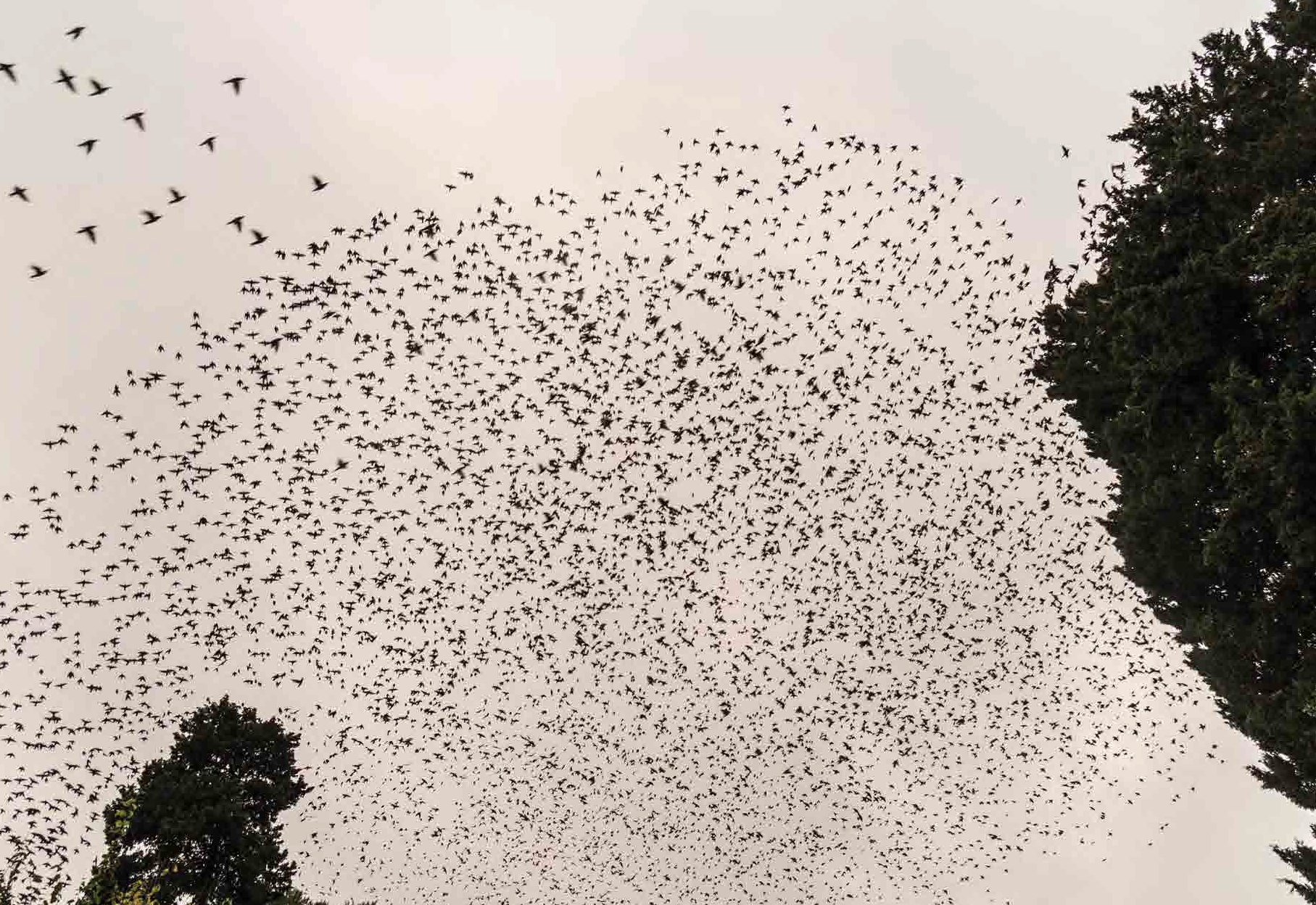
L.C.T: Yes, I worked on migrant camps in Sicily. I went there by ferry. Why by ferry? Because it was the way the military brought food to Lampedusa, but also because the place where they were in transit corresponded to the movement from what is called a “bird dormitory,” the largest in Rome, which is the Verano Cemetery. The cemetery has enormous cypresses, and the swallows, known as common swallows, migrated in the opposite direction. Thus, I decided to create a series called Cúpula Celeste. The name Cúpula Celeste refers to the star cartographies on which navigators rely for navigation. I created a series by taking the ferries, trying to follow the same routes as them, but by ferry and photographing the sky. Therefore, it is a series that blends stars and birds.
In science, static does not exist: even the stars migrate! In France, the Natural History Museum published a Manifesto with the scientists of the botanical garden on migration.
I love this phrase by Paul Auster, which states that art is a game, a game that must be taken seriously. Many things are fortuitous, accidental, but they must be treated with seriousness.
Thank you to Luis Carlos.